ABOUT LUMENLITHOS
Light reveals.
Science defines.
Every mineral has a story waiting to be discovered. We develop light and observation instruments to reveal the properties that ordinary sight leaves hidden.
Discover our origin ↓Some mineral stories are immediately visible. Others remain hidden for millions of years, revealing themselves only under the right conditions.
At LumenLithos, light is more than a way to illuminate a display. It is a scientific tool: a controlled input that can reveal fluorescence, contrast and optical behaviour invisible to the human eye.
Our goal is not simply to manufacture lighting. It is to create instruments that help collectors, museums, educators, photographers and researchers see more—and understand what they see.
01 / WHY WE EXIST
Illumination is not
the destination.
BECAME TEN
WHERE IT ALL STARTED
A childhood fascination,
found again.
As a child, founder Mark Bos owned the educational mineral collection The Treasures of the Earth. Hours spent studying those specimens became an early lesson in how much beauty an ordinary-looking stone can hold.
Years later, on holiday in Szklarska Poręba in Poland’s Giant Mountains, a piece of smoky quartz on a parking lot brought that fascination rushing back. One stone became two. Two became ten. Walks along the historic Walen Route revealed quartz, jasper, rose quartz and a region shaped by mineral history.
Back home, the wish to display a growing collection properly led to a deceptively simple question: what is the right light for a mineral?
03 / THE SPECTRAL PROBLEM
A peak wavelength
is only part of the story.
Consumer “UV” sources often operate around 395–400 nm and emit substantial visible violet light. The mineral may fluoresce, but so does the entire scene: backgrounds appear, contrast falls and the hidden response becomes harder to read.
Even products sold as 365 nm can extend into the visible range. That changed our approach. We do not judge a source by its peak wavelength alone—we examine its complete spectral behaviour.
The scale spans 200–420 nm. Ultraviolet remains invisible; visible violet begins at approximately 380 nm. Different wavelengths can reveal different mineral responses.
04 / THE LUX SERIES
Quality of light
over quantity.
Lux is the name for our standalone lighting direction. Its principle is simple: provide clean, effective excitation for fluorescent minerals, with spectral quality taking priority over brightness claims in isolation.
Because a stronger-looking source is not necessarily a better scientific light. Wavelength, bandwidth, filtering, irradiance, geometry and thermal stability all matter.
Explore Lux Thyla →05 / BEYOND 365 NANOMETRES
One wavelength
cannot reveal everything.
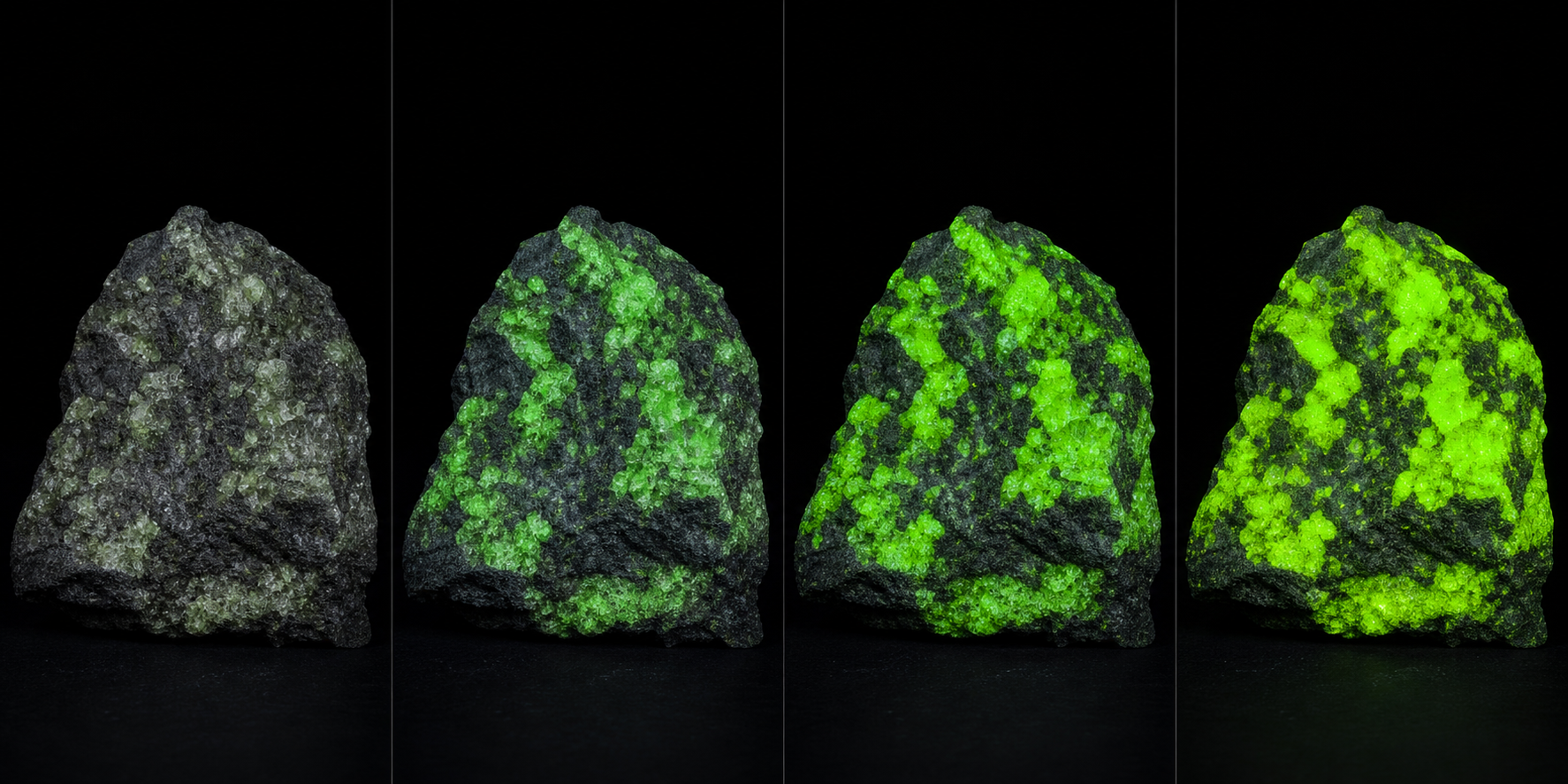
Some minerals respond beautifully at 365 nm. Others change at 310 nm, react to deeper UV, or show their classic response around 254 nm. Willemite made that limitation tangible: the expected brilliance remained hidden because the cabinet could not yet provide the right excitation.
But shorter wavelengths introduce a new responsibility. UVC can injure eyes and skin. Safe observation cannot depend on caution alone; it must be considered in the enclosure, controls and operating logic.
What if 254 nm
could be used safely?
06 / WILLEMITE ACROSS THE SPECTRUM
One specimen.
Four excitation bands.
One specimen. Four excitation bands.
Illustrative wavelength comparison
07 / THE BIRTH OF VISUS THECA
The Cabinet
of Vision.
Visus Theca is the concept for a purpose-built observation instrument: multiple carefully selected wavelengths inside an enclosed, safety-led environment.
Development goals include a closed ACRYLITE viewing door with door-triggered UV shutdown, complementary mechanical and electrical interlocks, wavelength-appropriate viewing barriers, independent white inspection light and carefully engineered controls.
Explore Visus Theca →08 / BUILT FOR DISCOVERY
Different users.
The same purpose.
To reveal details that would otherwise remain hidden—and to record those observations honestly, repeatably and safely.

“The right light doesn’t change the mineral.
It reveals what has always been there.”